
ECE R129/03 vs. ECE R129/04: Setting the Record Straight for Malaysian Parents (2026)

Lately, many Malaysian parents have been reaching out to us at Koopers to clarify some unverified information circulating online regarding the ECE R129 safety standard revisions.
We know how confusing these misleading claims can be, so we want to set the record straight and answer the big questions: What exactly is the difference between the ECE R129/03 and the newer ECE R129/04 car seat standards? Is the chest clip mandatory in the 04 revision? And is the 04 revision really “safer” than 03?
First, let’s start with the most important reassurance we can give you: If you currently own or are looking to purchase an R129/03 certified car seat, rest assured that your child is protected by one of the highest safety standards in the world.
The introduction of the 04 revision does not replace the core safety foundations of 03. It does not mandate a chest clip, and it is also important to understand that chest clips are not required under any safety regulation. Most European seats without chest clips meet strict safety standards using alternative design approaches, such as tightly angled shoulder straps and high‑friction harness systems that keep the child securely positioned during a crash.
Instead, R129/04 acts as a final administrative refinement—mainly focusing on clarifying regulations for booster seats and slightly updating testing protocols to match modern vehicles and the full phase‑out of the older R44 standard in Europe.
The Unshakable Core: What Both 03 & 04 Share
Before we look at the differences, it’s crucial to understand that the 04 revision leaves the heavy lifting of the R129 safety standard completely intact. Both revisions guarantee:
- Height-Based Sizing: You choose the right seat based on your child’s height, not just their weight, ensuring a much safer and more accurate fit.
- Advanced Side-Impact Testing: Mandatory testing for side collisions using highly advanced “Q‑series” dummies equipped with 32 sensors.
- Extended Rear-Facing: Children must remain in the safer rear-facing position until they are at least 15 months old.
- Extended Rear‑Facing: Children must remain in the safer rear‑facing position until they are at least 15 months old, and ideally up to around 105 cm or roughly 4 years old.
In short, the core ideas behind R129: better sizing, stronger side‑impact protection, and longer rear‑facing, are unchanged between 03 and 04.
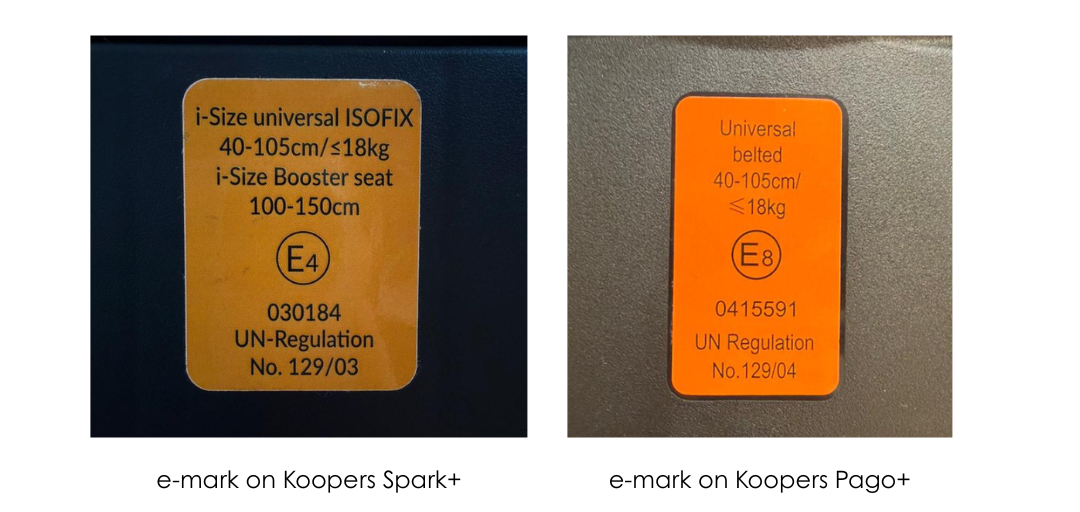
What was ECE R129/03 (2018/2019)?
The 03 revision was a massive and significant update to car seat safety. It brought several major improvements to the market:
- Belted Installation: It officially regulated and permitted child car seats to be safely installed using the vehicle’s 3‑point seat belt, not just ISOFIX. This gave parents more flexibility while still meeting strict safety limits on movement and stability.
- Booster Seat Limits: It introduced stricter requirements for backless booster seats (cushion boosters), ensuring they were only approved for older, taller children who could be properly restrained by the vehicle’s seat belt.
- Intuitive Usability: It mandated green‑coloured belt guides to make installing a seat belt much more intuitive for parents, reducing common installation errors such as twisted or mis‑routed belts.
R129/03 effectively set the modern baseline for R129‑approved seats sold in Europe and, increasingly, in markets like Malaysia that follow these standards.
What is ECE R129/04 (June 2024)?
Think of the 04 revision as the “polishing” or final administrative phase of the R129 standard. It consolidates earlier amendments and aligns fully with the final ban on the older R44‑series seats in Europe. Its primary focus remains on booster seats and testing environments that better reflect today’s cars.
Key updates in R129/04 include:
- The Shift to High‑Back Boosters: R129/04 further clarifies booster‑seat criteria. It aims to phase out “cushion‑only” boosters in favour of backrest boosters to guarantee superior side‑impact protection, better head‑positioning, and proper belt routing for older children.
- Modernized Testing for Boosters: It subtly refines the crash‑test dummy protocols and test‑bench configurations for booster seats, making tests more representative of modern vehicle interiors and belt geometries.
Crucially, the 04 revision does not add entirely new safety concepts; it refines how the standard is applied, especially around booster‑seat approvals and test conditions.
Summary of Differences
Below is a quick comparison of the two revisions to help you make sense of the changes:
| Feature | R129/03 (2018/2019) | R129/04 (June 2024) |
| Primary Focus | Major update for belted installations and early booster‑seat rules. | Final administrative refinement, strong focus on high‑back boosters. |
| Booster Seats | Regulated boosters with and without backrests; stricter limits for backless types. | Refines rules to strongly favour backrest boosters and discourage cushion‑only models. |
| Belted Installation | Permitted via seat belt; tightened rules on movement and stability. | Permitted, with further optimized testing environments that mimic modern cars. |
| Side Impact Test | Included and mandatory using Q‑series dummies. | Included, with refined, modernised test protocols especially for booster‑seat setups. |
Importantly, the 04 revision does not make 03‑approved seats “unsafe” or “outdated.” It simply updates how the standard is written and tested, especially around boosters and installation scenarios.
The Koopers Conclusion
The R129 standard has been evolving since 2013 to make car seats safer and easier to use. The transition from 03 to 04 is simply the next step in the evolution of R129 safety standard, reflecting the latest advancements in safety testing for booster seats and belted installations, without replacing the core safety foundation of the 03 revision.
Whether your car seat is R129/03 or R129/04 approved, you are providing your child with top‑tier, rigorously tested protection as required by the R129 standard.
For parents who love to dive into the deep details, you can read the official UNECE Child Restraint Systems documentation for both the R129/03 revision here and the R129/04 revision here.
Ready to keep your little one safe? Explore Koopers’ range of ECE R129-approved baby car seats in Malaysia today and find the perfect ISOFIX or booster seat for your family’s next road trip!